
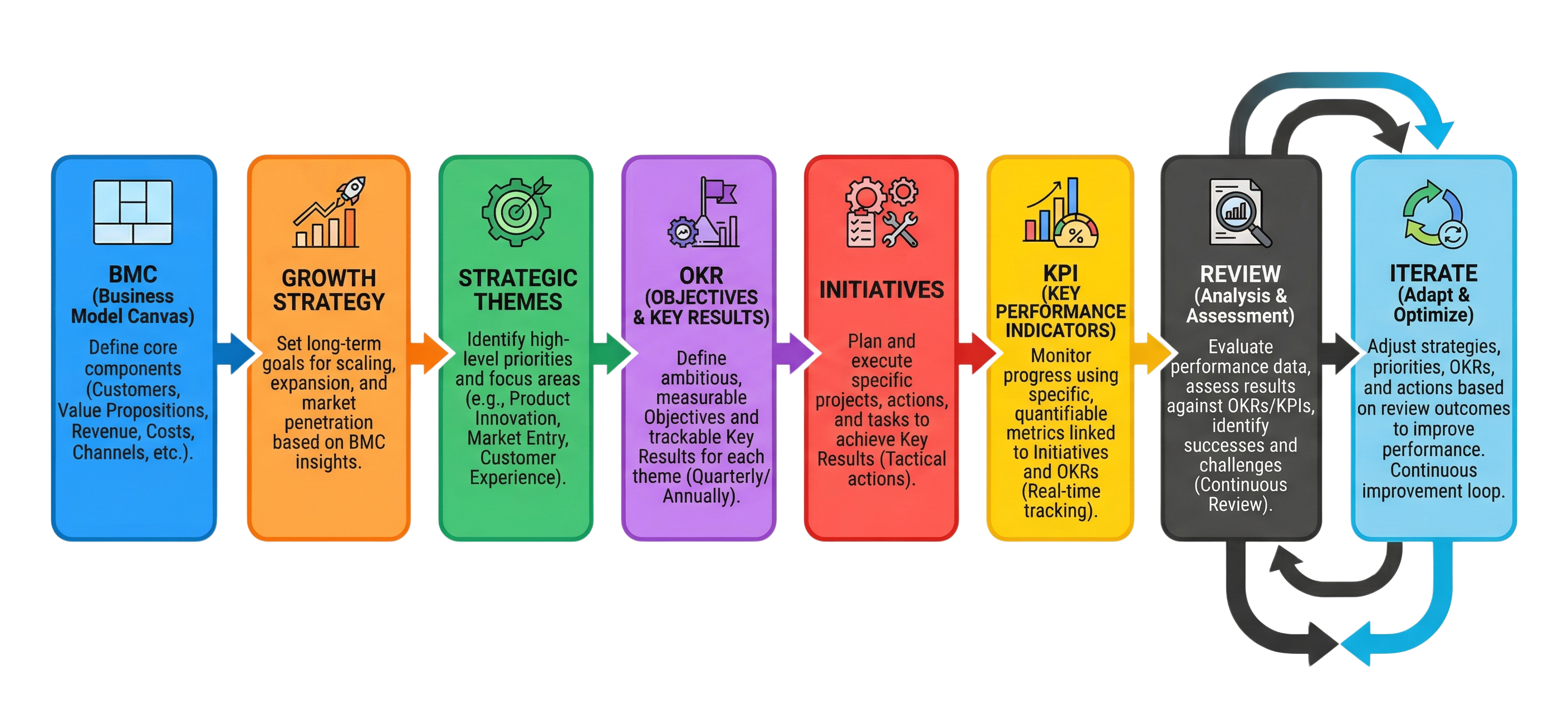
Six components.
One growth engine.
The Business Growth Management System is a unified operating model that connects six critical organizational components — from business model clarity to weekly execution rhythms — into a single, self-reinforcing growth cycle.
Frequently
asked questions.
A Business Growth Management System is an integrated organizational operating model that connects your business model (Business Model Canvas), growth strategy (Ansoff Matrix), execution priorities (OKR), and performance monitoring (KPI) into a single, coherent system. Unlike a traditional business plan — which is static — a BGMS is dynamic: it runs on weekly execution rhythms, quarterly reviews, and continuous learning loops. It ensures every person in your organization knows the direction, knows their role, and can see progress in real time.
BGMS is designed to be scalable in both directions. The same core principles apply whether you're a 3-person UMKM or a 500-person enterprise — but the complexity and scope of implementation differ significantly. For small businesses, we typically focus on a simplified BMC, one or two Strategic Themes, three to five KPIs, and a simple OKR at the company level. For larger organizations, we deploy the full eight-module system with department and individual-level OKR cascading. The principle is always the same: grow with direction, not just momentum.
OKR (Objectives and Key Results) and KPI (Key Performance Indicators) serve fundamentally different purposes. OKR is a tool for change — it answers "where are we going and how far?" It is aspirational, time-bound, and designed to drive growth. KPI is a tool for stability — it answers "are we healthy and on track?" It monitors operational performance consistently over time. In the BGMS model, OKR is your compass and KPI is your dashboard. You need both: without OKR, KPI-only organizations become stagnant; without KPI, OKR-only organizations risk destabilizing their business while chasing ambition.
A typical full BGMS engagement follows four phases: Diagnose (2–3 weeks), Design (3–4 weeks), Deploy (4–8 weeks), and Drive (ongoing). From kick-off to the first fully operational quarterly OKR cycle, most organizations achieve full deployment in 12–16 weeks. The "Drive" phase is ongoing and transitions from intensive consulting to advisory support as your team builds internal BGMS capability. We aim to make ourselves progressively redundant — your success is measured by your team's ability to run the system independently.
PillarGrowthMetrics is our proprietary BGMS software platform — an ERP-integrated system with eight modules covering Values Management, Business Model Canvas, Strategic Themes, OKR, KPI Dashboards, ERP Integration, Execution Cadence, and Learning Loop. The software is not mandatory for BGMS implementation — many clients begin with consulting and manual tools (spreadsheets, digital whiteboards). However, as your organization scales and the volume of OKRs, KPIs, and review cycles grows, the software dramatically increases efficiency and data quality. We offer it as a standalone product or bundled with consulting services.
The BGMS framework is industry-agnostic by design — the Business Model Canvas and OKR/KPI systems apply equally well across sectors. Our consultants have worked with digital startups, F&B businesses, SaaS companies, education providers, non-profit organizations, professional services firms, and manufacturing SMEs. That said, we have deepest expertise in technology companies, education businesses, and service-based organizations across Indonesia and Southeast Asia. Our diagnostic process adapts to the specific dynamics of your sector, customer segment, and competitive environment.
Success is measured against the growth metrics we baseline at the start of the engagement. Typical outcomes our clients track include: revenue growth rate (MoM or YoY), customer acquisition cost reduction, improvement in retention rate, OKR completion rate (the percentage of Key Results achieved each quarter), and CLV:CAC ratio improvement (our target is CLV ≥ 3× CAC). Beyond financial metrics, we also measure organizational capability: can your team run the quarterly OKR cycle independently? Are decisions being made on data rather than instinct? Does your leadership team have a shared strategic language? These are leading indicators of long-term growth system health.
Interested in implementing BGMS with Dinamigra?
Let’s collaborate to build a management system that drives real impact for your business growth.
.